
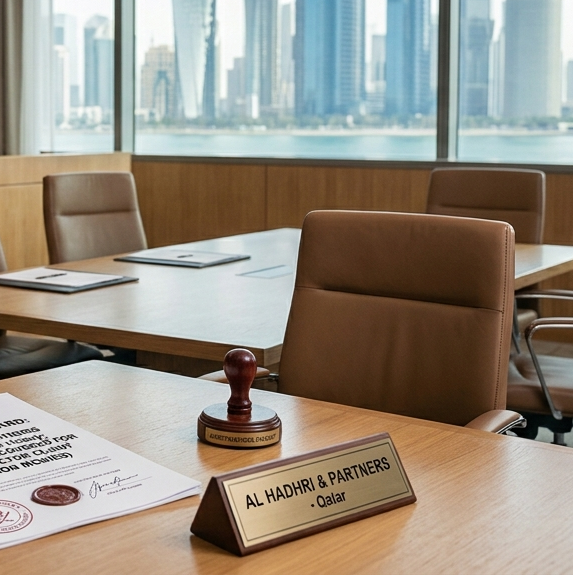
Al Hadhri & Partners is pleased to announce the successful representation of a subcontractor client in a construction arbitration concerning the recovery of outstanding retention monies exceeding QAR 4.7 million.
The dispute arose under a major construction project in the State of Qatar, where our client — acting as subcontractor — had successfully completed the supply, delivery, installation, and commissioning of furniture works. Following the issuance of the Final Completion Certificate and the expiry of the contractual 400-day Defects Liability Period, the subcontractor became contractually entitled to release the remaining retention amount.
Despite the fulfilment of all contractual requirements, the Main Contractor refused to release the outstanding retention and sought to rely on the subcontract’s back-to-back payment provisions, arguing that payment remained conditional upon its own receipt of corresponding funds from the Employer — effectively advancing a “pay-if-paid” defense before the Arbitral Tribunal.
A Decisive Distinction: “Pay When Paid” vs. “Pay If Paid”
Acting on behalf of the Claimant, Al Hadhri & Partners successfully challenged this position, relying on the principles affirmed by the Qatar Court of Cassation in Appeal No. 1460/2023, which drew a clear line between a permissible “pay when paid” mechanism and an impermissible “pay if paid” arrangement.
Our team demonstrated that while payment may be deferred for a reasonable period pending receipt of funds, a main contractor cannot indefinitely withhold or extinguish a subcontractor’s right to payment once that subcontractor has fully fulfilled its contractual obligations.
No Discharge Certificate Requirement Under the Subcontract
The Main Contractor further argued that release of the retention was contingent upon issuance of a Discharge Certificate by the Employer under the Main Contract. We successfully established that no such requirement existed under the Subcontract, and that — under the principle of privity of contract — obligations arising under the Main Contract could not be imposed on the Subcontractor absent an express contractual provision.
The Tribunal accepted the Claimant’s position in full, confirming that the Subcontract contained a complete and self-contained mechanism governing the release of retention monies, and that the subcontractor’s entitlement to payment could not be subjected to additional conditions agreed between the Employer and the Main Contractor under a contract to which the subcontractor was not a party.
The Outcome
Following extensive written submissions, witness preparation, contractual analysis, and oral advocacy, the Arbitral Tribunal rendered an award in favor of our client, ordering payment of the outstanding retention amount together with arbitration costs.
This award serves as an important reminder to participants in Qatar’s construction industry: contractual payment rights cannot be indefinitely withheld through reliance on back-to-back payment provisions where a subcontractor has fully discharged its obligations and satisfied the conditions governing payment under its subcontract.
The result reflects Al Hadhri & Partners’ continued expertise in construction disputes, commercial arbitration, and complex contractual claims — and our commitment to securing commercially significant outcomes for our clients.